May 23, 2026 • Maren Calloway • 9 min reading time • Prices verified June 6, 2026
Standing Easel Chalkboards for Kids: Separating Sturdy Pine From Wobbly Particle Board
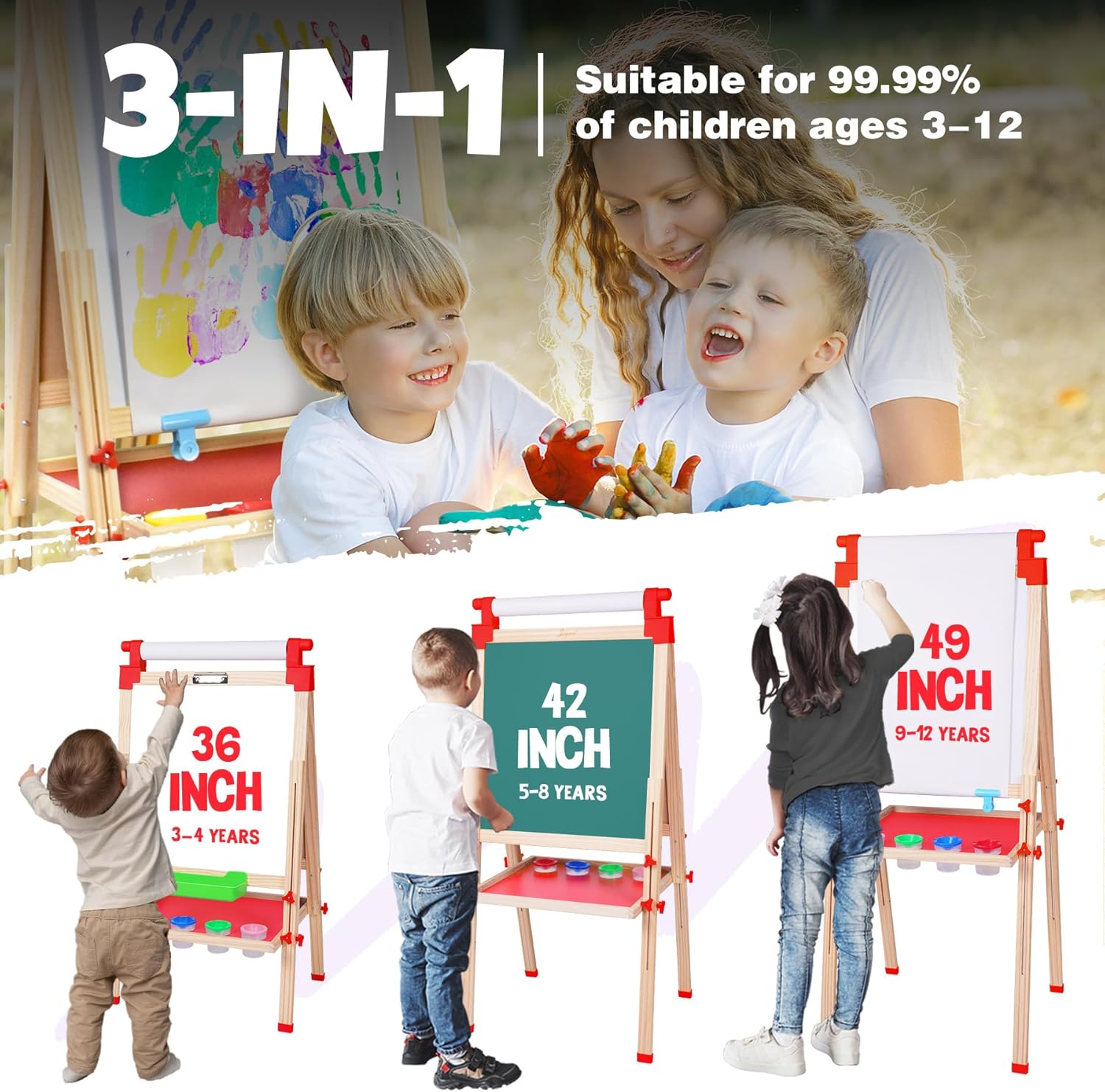
A kids’ standing easel chalkboard is exactly what it sounds like: a freestanding A-frame stand — shaped like the letter A — that holds a flat drawing surface at a child’s eye level, with one side typically coated for chalk drawing and the other for dry-erase markers or a magnetic clip-strip for paper. They’re sold everywhere from big-box toy aisles to Montessori supply shops, and the price range ($30 to $200+) is wide enough to be genuinely confusing. The catch is that two easels sitting on the same shelf at similar price points can be built from completely different materials — one from solid pine (a natural, dense wood that handles knocks and resists warping), the other from particle board (a manufactured wood product made of compressed wood dust and glue, which is lighter and cheaper but more vulnerable to moisture and stress). That material difference is almost invisible in a product photo and rarely spelled out clearly in a listing title. This guide cuts through the spec-sheet fog so you can make a confident call before the box arrives.
| EDITOR'S PICK[Tiny Land Kids Easel – Large 22…](https://www.amazon.com/dp/B0FPWWP7RV?tag=greenflower20-20) | Mid-tier[JOYOOSS Kids Wooden Easel with…](https://www.amazon.com/dp/B0DJ282HBQ?tag=greenflower20-20) | Budget pick[Tabletop Painting Wooden Art Ea…](https://www.amazon.com/dp/B0F7H18JW6?tag=greenflower20-20) | |
|---|---|---|---|
| Board Size | 22"x40.5" | — | — |
| Adjustable Height | — | ✓ | — |
| Paper Roll | — | ✓ | — |
| Age Range | — | 3-12 Years | 2-4 |
| Price | $119.99 | $69.99 | $29.99 |
| See on Amazon → | See on Amazon → | See on Amazon → |
Why the Frame Material Is the Whole Decision
Here’s the honest framing for anyone mid-purchase: the chalkboard surface on most easels in the $40–$120 range is fine. It’s usually either a melamine-coated MDF panel (MDF = medium-density fiberboard, a denser and more uniform engineered wood than particle board) or a steel sheet with a chalkboard-painted finish. Those surfaces perform similarly at this price tier. What separates a three-year easel from a three-month easel is almost always the frame.
Solid pine or birch frames flex under a child’s enthusiastic drawing without cracking at the joints. Particle board frames — held together with cam-lock fasteners and a thin wood-grain veneer — tend to strip at the screw holes, bow when exposed to repeated humidity cycles (common in playrooms and classrooms), and eventually rack (shift out of square) so the easel wobbles even on flat floors.
Wirecutter’s evaluation framework for kids’ art easels specifically calls out frame stability as the primary durability variable, noting that testers look for solid-wood or all-metal construction over composite or particle board alternatives when longevity is a priority. Good Housekeeping’s best-easels roundup echoes this, flagging that lighter-weight easels in the sub-$50 range frequently show buyer feedback centered on joint failure within the first year of regular use.
The practical decision rule: if the listing doesn’t name the frame material explicitly, treat it as particle board until proven otherwise. Solid pine, solid beech, and solid birch are selling points manufacturers advertise loudly. Particle board is a selling point for no one, so brands that use it simply describe it as “wood” and move on.
The Four Frame Materials You’ll Actually Encounter
Solid Pine
Pine is the most common solid wood in kids’ easels because it’s lightweight, inexpensive relative to hardwoods, and easy to machine into the tapered leg profiles most easels use. A well-jointed pine frame — mortise-and-tenon or at minimum doweled joints reinforced with glue — holds up to years of use. The trade-off is that pine is a softwood, so it dents more easily than beech or birch. For a kid’s easel, that’s a minor cosmetic concern, not a structural one.
Owners of pine-framed easels consistently report the frames surviving three to five years in active playroom use, with The Spruce’s buying guide noting that solid-wood construction is the reliable differentiator at the mid-tier price point ($60–$100).
Birch and Beech
Both are hardwoods with tighter grain than pine, which means they resist denting, handle heavier panels without flex, and hold screws more firmly over time. You’ll find birch and beech frames most often in Montessori-adjacent products and in easels positioned at the $90–$180 end of the market. Bob Vila’s overview of furniture-grade woods confirms that birch’s screw-holding strength significantly exceeds pine’s, which matters at the joint points where easel legs spread under load.
MDF Panel (Surface, Not Frame)
Worth separating clearly: MDF is an excellent surface material for a chalkboard panel and a poor frame material. As a panel — the flat drawing surface itself — MDF gives a smooth, consistent chalk writing experience and is stable enough for a hanging-weight application. As a structural frame member under stress, it’s not rated for load-bearing joinery the way solid wood is. When a listing describes “MDF construction,” ask whether that means the surface panel or the frame legs. Usually it means both, and that’s where problems start.
Particle Board
The lowest-cost option in engineered wood. Particle board uses larger wood chips and shavings than MDF, making it less dense and less resistant to moisture. This Old House’s guide to furniture materials distinguishes particle board from MDF by noting that particle board’s larger chip structure means it swells and delaminates faster when it absorbs humidity — a real issue in a room where a young child is working with wet chalk, paint cups, or a water tray.
By the Numbers
| Frame Material | Typical Price Tier | Avg. Owner-Reported Lifespan | Screw-Hold Strength (relative) |
|---|---|---|---|
| Solid pine | $55–$110 | 3–5 years | Moderate |
| Birch / beech | $90–$180 | 5+ years | High |
| MDF (frame) | $45–$80 | 1–3 years | Low-moderate |
| Particle board | $30–$60 | Under 2 years | Low |
Lifespan estimates synthesized from aggregated buyer reviews and editorial roundups; screw-hold ratings relative to each other, not absolute engineering values.
Reading a Listing Like a Practitioner
You’re looking at four or five easel listings and trying to triage them in under ten minutes. Here’s the filter sequence:
Step 1 — Find the frame material call-out. Search the product description for “solid pine,” “solid wood,” “birch,” or “beech.” If none of those words appear and the description just says “wood” or “wooden frame,” default to suspicion.
Step 2 — Check the weight. Solid pine easels in the 36–48-inch height range typically weigh between 7 and 12 pounds assembled. Particle board easels of the same dimensions often come in under 6 pounds — lighter sounds good, but in an easel it’s a structural signal, not a feature.
Step 3 — Read the one-star reviews specifically for joint and wobble language. Phrases like “wobbles immediately,” “screws stripped after a month,” “the legs spread apart,” and “leans to one side” are the particle board failure mode described in plain language. This Old House’s furniture-durability coverage notes that joint failure at the screw point is the primary collapse mode for composite-framed furniture under repeated-load conditions.
Step 4 — Look for a height-adjustment mechanism description. Quality solid-wood easels typically use a wing-nut or ladder-rung adjustment system along the frame’s central spine. Particle board easels often skip this or use a thin metal clip that reviewers across multiple platforms describe as one of the first components to fail.
Step 5 — Check whether the chalkboard panel is described separately from the frame. A listing that says “MDF chalkboard surface with solid pine frame” is giving you useful information. A listing that just says “chalkboard easel, quality wood construction” is not.
The Surface Side: Chalk vs. Dry-Erase vs. Magnetic
Most dual-sided easels in the $55–$130 range pair a chalkboard panel with either a dry-erase (whiteboard) panel or a magnetic panel on the reverse. The tradeoffs matter for how you’ll actually use it.
Chalkboard side: Either a painted MDF panel or a thin steel sheet with chalkboard paint. Before first use, it requires seasoning — rubbing the flat side of a chalk stick across the entire surface and then erasing it, which fills the surface’s microscopic texture and prevents ghosting (the faint outlines of old drawings that don’t fully erase). Good Housekeeping’s easel coverage specifically calls out ghosting as the most common first-week complaint from buyers who skip this step.
Dry-erase side: Melamine-coated panels erase cleanly for the first year or two; lower-quality panels start staining (called ghosting on whiteboards too, confusingly) after heavy use. Look for “tempered glass dry-erase” or “porcelain” surface language if longevity matters — though those materials appear almost exclusively above the $150 price point.
Magnetic surface: Thin steel panels can hold magnets, which doubles as a display surface for alphabet magnets or artwork clips. Worth having if this easel is pulling duty as a learning station rather than purely a drawing surface.
When Size Matters More Than You’d Think
Standard kids’ easel heights run 36 inches (toddler-focused), 42–44 inches (preschool to early elementary), and 48 inches (adjustable, covering ages 3–10+). The 42–44-inch fixed-height range is the most common, but owners consistently report that kids outgrow it by age seven or eight, especially for standing drawing.
The Spruce’s guide to kids’ art furniture recommends prioritizing adjustable-height models if you want a five-year lifespan out of the purchase — the cost premium ($15–$25 at the mid-tier) pays back quickly when you don’t replace it at the midpoint of a child’s prime drawing years.
Classroom buyers sourcing multiple units should note that 48-inch adjustable-height easels cover the widest age band and typically feature more robust frame joinery simply because taller frames undergo more torque stress — which means manufacturers use heavier gauge wood or metal hardware to compensate.
The Clear Decision Framework
If your budget is $30–$50: You are almost certainly getting a particle board or thin-MDF frame. That’s a reasonable trade-off for a very young child (ages 2–3) who will use it lightly and may outgrow it in two years anyway. Buy with that lifespan expectation clearly set, season the chalkboard surface before use, and don’t expect it to survive a move or a shared-playroom environment.
If your budget is $55–$90: This is the range where solid pine is available but not guaranteed. Use the five-step listing triage above. The Wirecutter analysis of this category consistently finds that the best value sits in the $65–$80 band for pine-framed models with a steel magnetic/chalkboard combo surface.
If your budget is $90–$180: You should be buying solid birch or beech, or a steel-and-solid-wood hybrid frame. If a listing at this price tier can’t confirm solid-wood construction, it’s overpriced for what it is, and you should move down the page.
If you’re outfitting a classroom or activity room with multiple units: Prioritize metal-frame or solid-birch easels from suppliers who can confirm consistent material sourcing across a bulk order. The cost difference between a $60 particle board easel and a $90 solid pine easel is $30 per unit — but replacing three easels in year two costs more than buying the better version to start.
The core rule hasn’t changed since the introduction: solid pine and birch frames last; particle board frames don’t. Everything else in this guide is just the tooling to find one from the other before checkout.