April 16, 2026 • Maren Calloway • 8 min reading time • Prices verified June 6, 2026
Classroom and Commercial Chalkboard Tables: What ECR4Kids and Bentwood Sets Offer That Budget Picks Don't
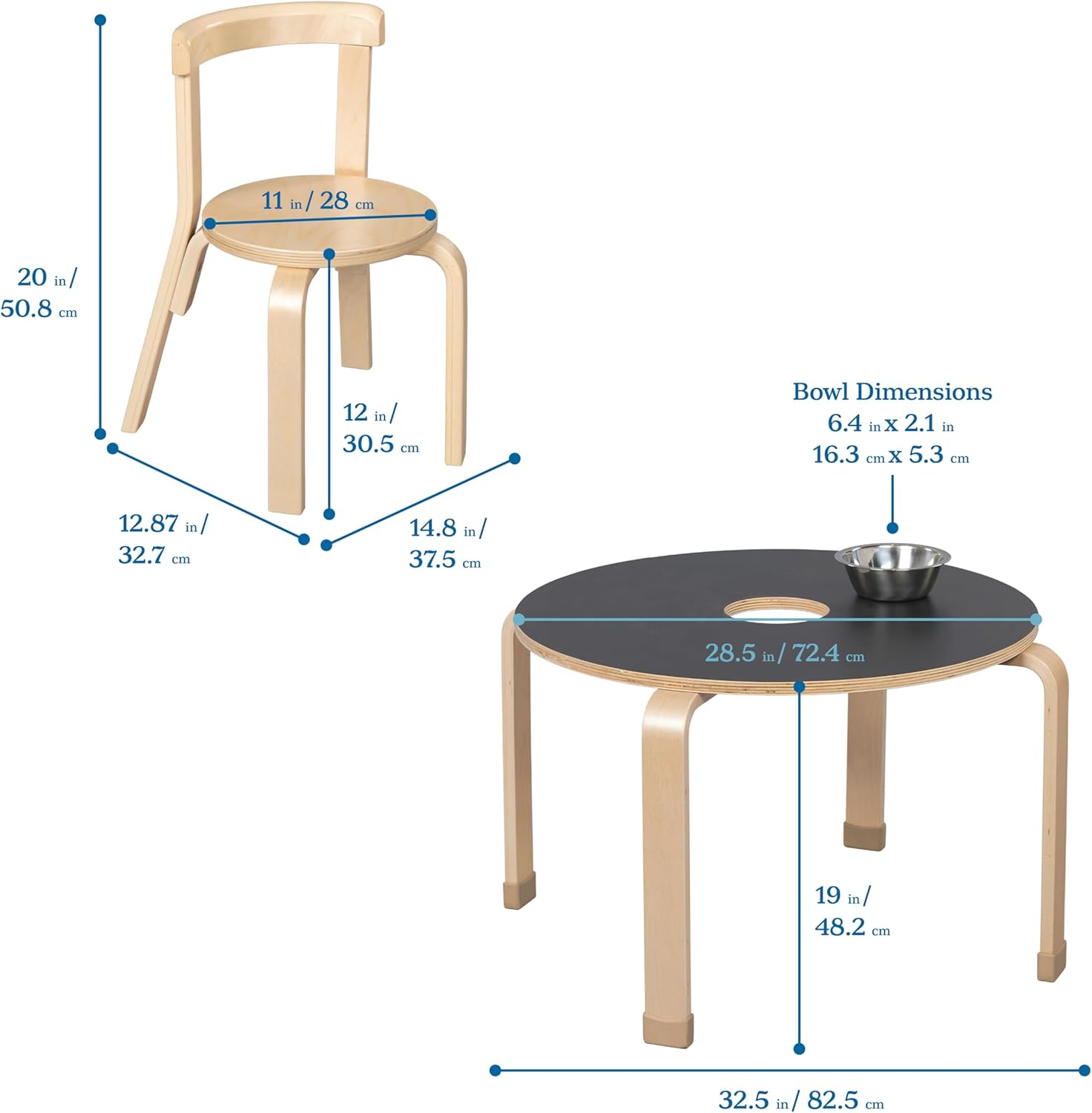
A chalkboard table is exactly what it sounds like: a table whose surface doubles as a writing or drawing area using standard chalk, with no paper needed. The appeal is real — kids can draw directly on the tabletop, teachers can label station areas, and restaurant operators can use the surface for rotating menu displays. But not all chalkboard tables are built the same way, and the difference between a $65 import and a $180–$350 ECR4Kids or Bentwood set isn’t just brand markup. It’s surface material, frame engineering, certification status, and what happens to the table after three years of daily use. If you’re making a buying decision right now — for a classroom, a childcare center, or a hospitality display setup — this article will walk you through exactly where the money goes and whether it’s worth it for your situation.
The Surface Question First: MDF vs. Solid-Core Chalkboard Panels
The single most consequential spec on a chalkboard table isn’t the frame — it’s the writing surface itself. Budget tables overwhelmingly use a thin layer of chalkboard-painted MDF (medium-density fiberboard, an engineered wood product made from compressed wood fibers and resin) glued over a basic substrate. ECR4Kids uses a similar MDF-core construction in several lines, but the difference lies in surface thickness, paint formulation, and edge treatment.
ECR4Kids publishes its surface specs with more transparency than most competitors at this price tier. Their chalkboard activity tables in the ELR series use a laminated MDF panel with a factory-applied chalk-paint finish that is documented as passing GREENGUARD Gold certification — a third-party standard (run by UL Environment) confirming that chemical emissions from the product meet strict limits for children’s environments. That certification matters in a way that is often underappreciated: many school districts and licensed childcare facilities are contractually or legally required to source GREENGUARD-certified furniture. A budget import without that documentation can create a compliance headache that costs more than the price difference to unwind.
What ghosting means and why it matters here: “Ghosting” is the term for chalk residue that remains faintly visible on a chalkboard surface after erasing. It’s caused by chalk dust penetrating micro-pores in the surface coating. Budget MDF surfaces tend to ghost more aggressively after the first few months because the paint layer is thinner and degrades with cleaning. ECR4Kids product reviewers on institutional procurement platforms consistently note that the factory finish holds up through the first 12–18 months of classroom use before ghosting becomes noticeable — a meaningful improvement over the 3–6 month window frequently reported for unbranded imports.
Bentwood’s approach is different. Several Bentwood commercial table lines use a high-pressure laminate (HPL) chalkboard surface rather than a painted finish. HPL — think of it as a very dense, heat-fused layer applied to a core — is harder than painted MDF and resists ghosting significantly better over time. It also costs more, which is why Bentwood sets tend to run $250–$500 for a table-and-chair set versus ECR4Kids’ $130–$280 range. For a daycare or preschool running two shifts of children daily, the HPL surface math usually favors Bentwood on a 5-year cost basis, even accounting for the higher upfront spend.
Frame Engineering: Weight Ratings, Stackability, and the Height-Adjustment Factor
Frame construction is where budget tables most visibly cut corners, and it’s also where institutional buyers — schools, childcare directors, commercial operators — absorb the cost of that cutting most directly.
ECR4Kids frame specs (per published product documentation):
- Steel tube frames powder-coated (a dry-paint process that bakes to a durable, chip-resistant shell) in multiple heights
- Height-adjustable models (the adjustable-height ELR series) rated for adjustment between approximately 14” and 22” — covering preschool through early elementary ergonomic ranges
- Static weight rating: manufacturer-documented at 50 lbs surface load for standard models
- Stackable chair sets sold as companions rated to stack 10 units
Bentwood commercial frame specs (per published spec sheets):
- Welded steel frames, typically heavier gauge than ECR4Kids’ residential-adjacent lines
- Glides or caster options available on commercial configurations
- Some configurations specify 100 lb surface load ratings on institutional models
The stackability point is operationally significant for anyone managing a multi-room facility. If you’re running a summer program where tables need to move between spaces and be stored vertically, a set rated and tested for stacking with a weight-bearing specification in writing is a procurement asset. Budget sets rarely publish stack ratings at all, which is a red flag in commercial settings.
Height adjustability is a feature that sounds minor until you realize a fixed-height table purchased for 3-year-olds is the wrong height for 5-year-olds by the time your program’s enrollment shifts. ECR4Kids’ adjustable-height models are documented to span a range that covers most early childhood age bands, which effectively extends useful product life without re-purchasing.
Certifications That Actually Move Procurement Decisions
In educational and commercial environments, certifications aren’t just marketing language — they’re gate-keepers for institutional purchase approval. Here’s what’s in play for this category:
GREENGUARD Gold (formerly known as GREENGUARD Children & Schools): As noted above, ECR4Kids holds this certification on key product lines. Per the UL Environment GREENGUARD Gold certification database, qualifying products must meet stricter chemical-emission thresholds than standard GREENGUARD, specifically calibrated for environments where children spend extended time. If your district or licensing body requires this, it’s binary: either the product has it or you can’t buy it.
NSF/ANSI 51: This standard — published by NSF International, the independent public health organization — covers food equipment materials. It’s relevant for any chalkboard table used in a food-adjacent commercial setting, such as a restaurant display table where food items might be placed directly on or near the surface. Budget chalkboard tables virtually never carry NSF/ANSI 51 documentation. Neither do most ECR4Kids educational models, which aren’t designed for that use case. If you’re sourcing for a hospitality or foodservice application, this pushes you toward commercial-grade suppliers like American Metalcraft or Cal-Mil rather than educational furniture brands — and that’s the honest answer even if it means a smaller product universe.
ASTM F963 (toy safety standard): Some ECR4Kids products reference compliance with this standard for paint and surface materials. While it’s primarily a toy standard, its presence signals that paint formulations have been reviewed against known toxicity benchmarks — meaningful for surfaces small children will touch repeatedly.
The Spruce’s March 2026 roundup of kids’ art tables flagged the certification gap between institutional brands and import-heavy budget picks as a primary differentiator for buyers in licensed childcare settings — confirming what procurement-experienced buyers already know.
The Math: What You’re Actually Paying Per Year of Useful Life
Here’s a straightforward comparison based on published pricing and documented durability patterns as of mid-2026:
| Product Tier | Upfront Cost (table + 4 chairs) | Documented Surface Life (before ghosting/wear) | Est. Annual Cost |
|---|---|---|---|
| Budget import set | $60–$90 | 6–12 months functional surface | $60–$90/yr |
| ECR4Kids ELR series | $150–$280 | 18–36 months (reviewer consensus) | $50–$93/yr |
| Bentwood HPL commercial | $280–$500 | 48–72 months (spec-grade HPL) | $47–$83/yr |
This math doesn’t account for the compliance cost of buying a non-certified product in a licensed facility (which can be significant) or the labor cost of replacing furniture more frequently. Furniture Today’s Q1 2026 commercial education furniture analysis noted that total cost of ownership — not sticker price — is the metric driving institutional purchasing decisions toward mid-tier brands, with ECR4Kids specifically cited as gaining market share in the $100–$300 segment.
Decision Rules: If X, Then Y
You’ve read the specs. Here’s how to translate them into an actual buying decision.
If you’re equipping a licensed childcare center or school district that mandates GREENGUARD Gold: ECR4Kids is your minimum viable option in this price tier. Budget imports don’t meet the documentation bar. Verify the specific model number against the current UL GREENGUARD certification database before issuing a PO — certification applies per-product, not per-brand.
If you’re running a daycare or preschool with a 3–5 year planning horizon and daily multi-shift use: The Bentwood HPL surface justifies its premium. The annual cost math converges with ECR4Kids at year 3 and favors Bentwood from year 4 onward, based on published surface-durability characteristics.
If you’re a single classroom teacher or a parent setting up a home learning space, buying one table: ECR4Kids hits the sweet spot. The certification is real, the height-adjustability adds lifespan, and the price delta over budget alternatives ($80–$150) is recoverable in avoided replacement within 18–24 months based on documented reviewer patterns.
If you need chalkboard display tables for a foodservice or hospitality setting: Neither ECR4Kids nor Bentwood is your primary answer. Route that search toward NSF/ANSI 51-compliant commercial suppliers. American Metalcraft and Cal-Mil publish compliance documentation; ECR4Kids does not position its products for food-contact applications and doesn’t publish that documentation.
If budget is the binding constraint and certification requirements don’t apply: A budget set is defensible for light home use — but season the surface before first use (meaning: apply chalk across the entire surface, let it sit for several minutes, then erase — this fills micro-pores and reduces early ghosting), and go in knowing you’re likely replacing in 12–18 months rather than 3–5 years.
One Honest Caveat
Our recommendations here are built from published specifications, certification databases, aggregated reviewer patterns, and institutional procurement reporting — not from owning or physically evaluating these tables ourselves. Product lines update, certifications lapse and renew, and pricing shifts. Before issuing any significant purchase order, verify the specific SKU’s current certification status directly with the manufacturer and confirm pricing with your distributor. ECR4Kids sells through its own site and through major educational supply distributors; Bentwood routes primarily through commercial furniture dealers. Both can provide updated spec sheets on request — and if a vendor can’t produce current documentation, that itself is data worth having.
The gap between budget and mid-tier chalkboard tables is real, quantifiable, and matters most in institutional settings. For everyone else, it’s a question of how long you need the surface to last and whether a certification stamp is a requirement or a nice-to-have.